
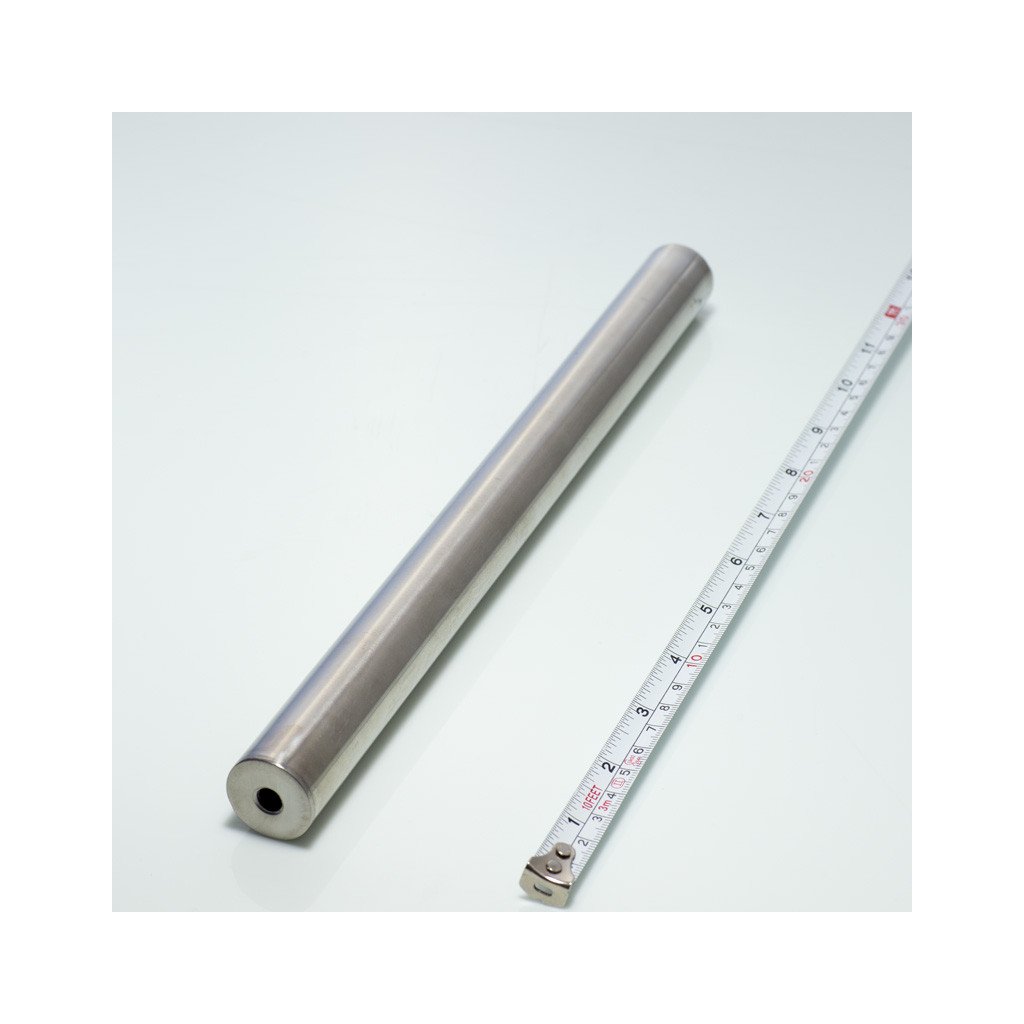
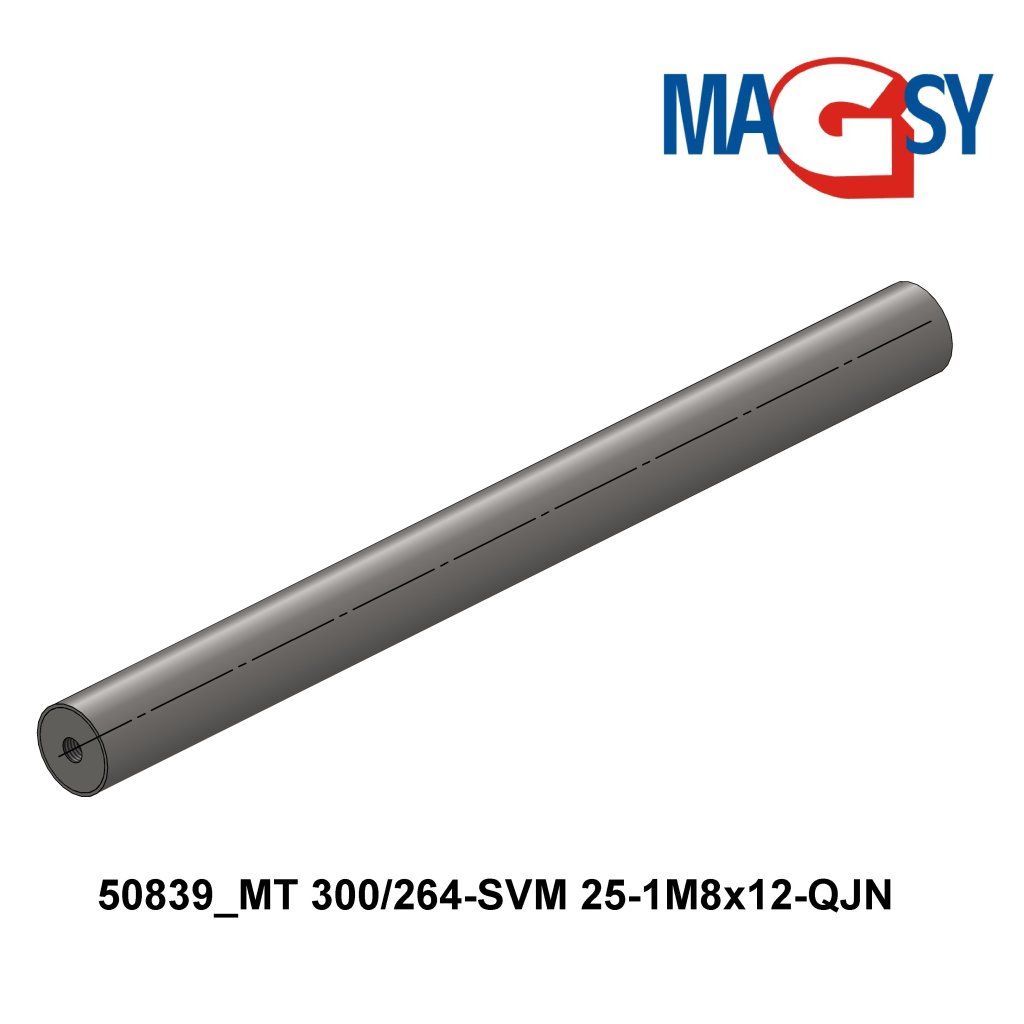


Magnetic rod intended exclusively for industrial use in non-continuous operations (when cleaning the magnetic rod, the flow of the purified material must be stopped) ensures perfect cleaning (magnetic separation) of your mixtures from ferromagnetic contaminants (by ferromagnetic contaminants we mean fully magnetic metals such as iron, nickel, cobalt and iron-containing alloys; not non-iron paramagnetic particles and very weakly magnetic materials – these materials must be separated by other methods). The magnetic rod is used for magnetic separation from dry, bulk and liquid materials.
For proper function, the purified bulk mixtures (material that you pour over the magnetic rod) must have the following properties:
- Homogeneous
- Dry with good flow properties, non-sticky, so that the material does not adhere to and stick to the magnetic rod; see below for the description of suitable materials for magnetic separation using a magnetic rod.
If the conditions of use differ, the material properties do not match the description above and the magnetic particles differ from those described by us, do not use this magnetic rod and contact our technical-sales department to confirm the suitability of using this magnetic rod or to select another magnetic separator.
The magnetic rod is used as a pre-stage to protect technology so that ferromagnetic contaminants do not enter equipment that they could damage, for example mill knives, crushers, nozzles of regranulation and granulation lines, injection molding machine nozzles, extrusion presses, pressing stations, presses for wet pressing, shredding equipment, fine sieves, ceramic pressing stations, glass presses, etc. It can also be used to purify a mixture to the highest possible cleanliness (meaning removal of ferromagnetic admixtures), where the magnetic rod is placed at the end of the production process just before packaging, dispatch, handling/transfer, so that no contamination occurs during subsequent operations in the production plant. In this case, it is assumed that the purified material is immediately sealed into closable packaging or other closable containers. Thanks to the very high magnetic force, there is a high capture rate of ferromagnetic contaminants (please read the detailed description below of what sizes of ferromagnetic contaminants this magnetic rod will capture).
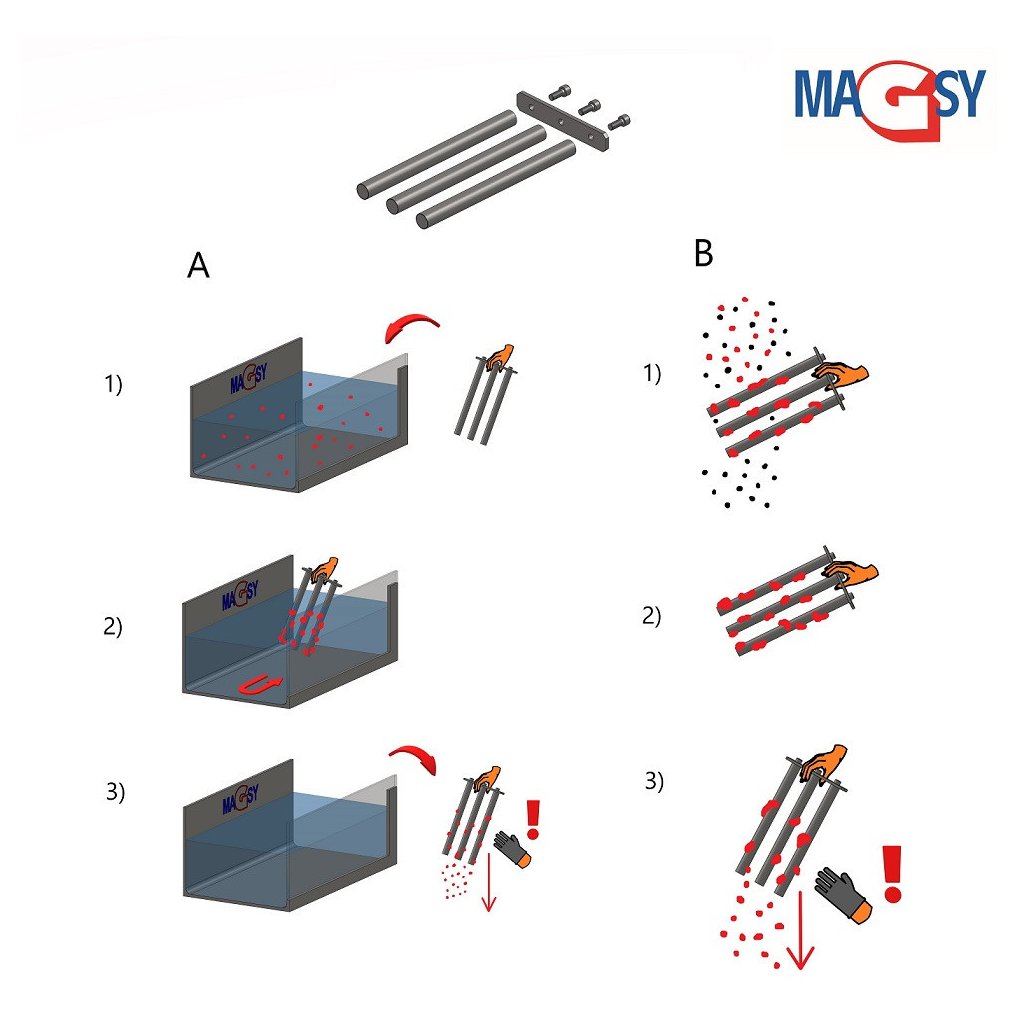
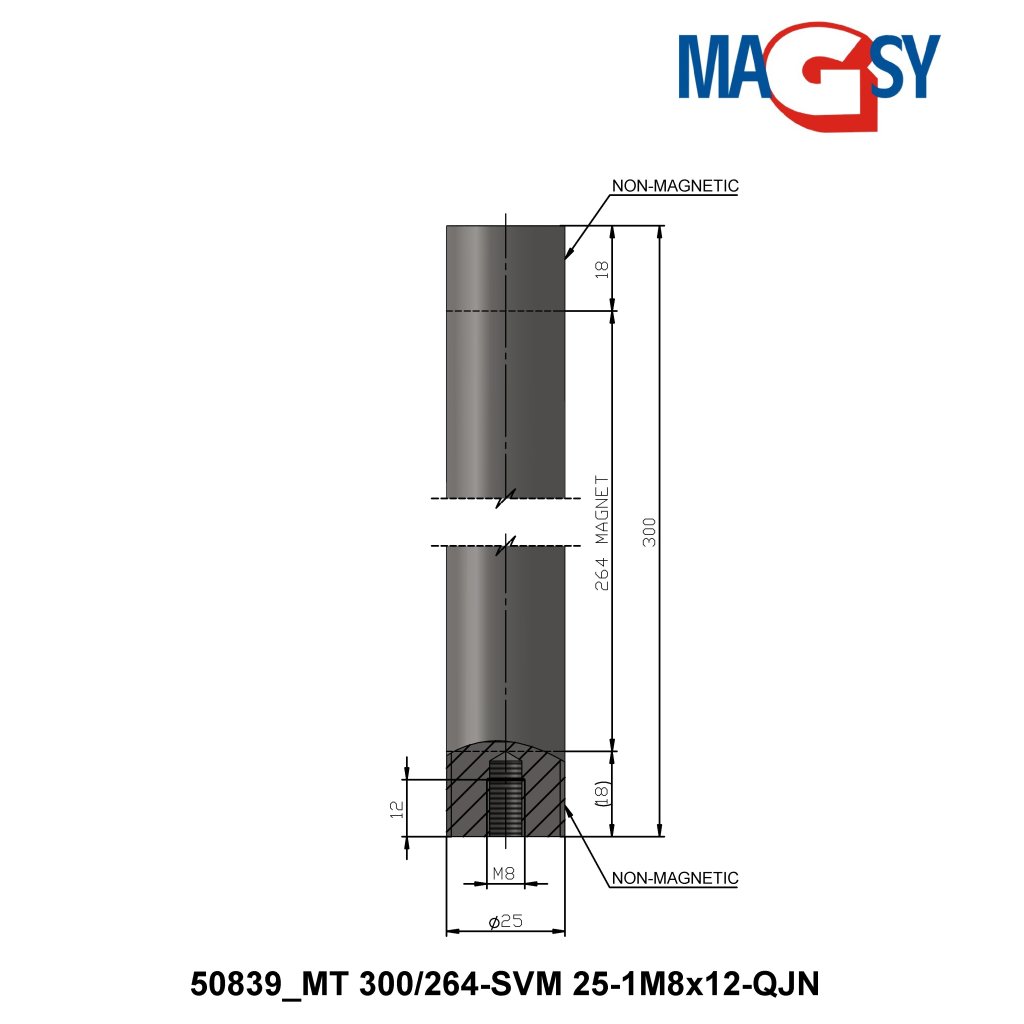
The magnetic rod is primarily intended for creating a magnetic grate according to the customer’s needs. It has a thread on one side. Using this thread, you can screw this rod to any flat steel plate or into another auxiliary structure designed by you. No auxiliary structures, flat steel plates, holders, or fastening materials are included with the delivery of the magnetic rod. Due to the very high magnetic force, we point out the necessity of using non-magnetic steel for all materials from which your auxiliary structure or any holder for mounting the magnetic rods will be made; likewise, fastening materials must be non-magnetic. The minimum distance between rods after installation on your auxiliary structure, holder, flat bar must not be less than 20 mm. This is for safety during installation and also to prevent the rods from being pulled together by magnetic force. Also consider the properties of the material (bulk and liquid) to maintain the required flow rate/throughput. If you design auxiliary holders for magnetic rods yourself, we cannot assume any responsibility for the correct function of the magnetic rods. If you are not sure about the installation or assembly into the form of a magnetic grate, do not buy the magnetic rod and contact our technical-sales department. We draw attention to the very high intensity of magnetic force. Take extreme caution when designing and manufacturing your own assembly for placing multiple magnetic rods next to each other, and especially when screwing them (any assembly) into a set—separate individual magnetic rods from each other with a non-magnetic spacer, e.g. a wooden board. There is an increased risk of injury when the magnetic rods connect! Keep all magnetic materials, structures, and tools such as hammers, pliers, vices at a minimum distance of 200 mm from the magnetic rods. Also watch out for the workbench—it must not be iron (ferromagnetic)!

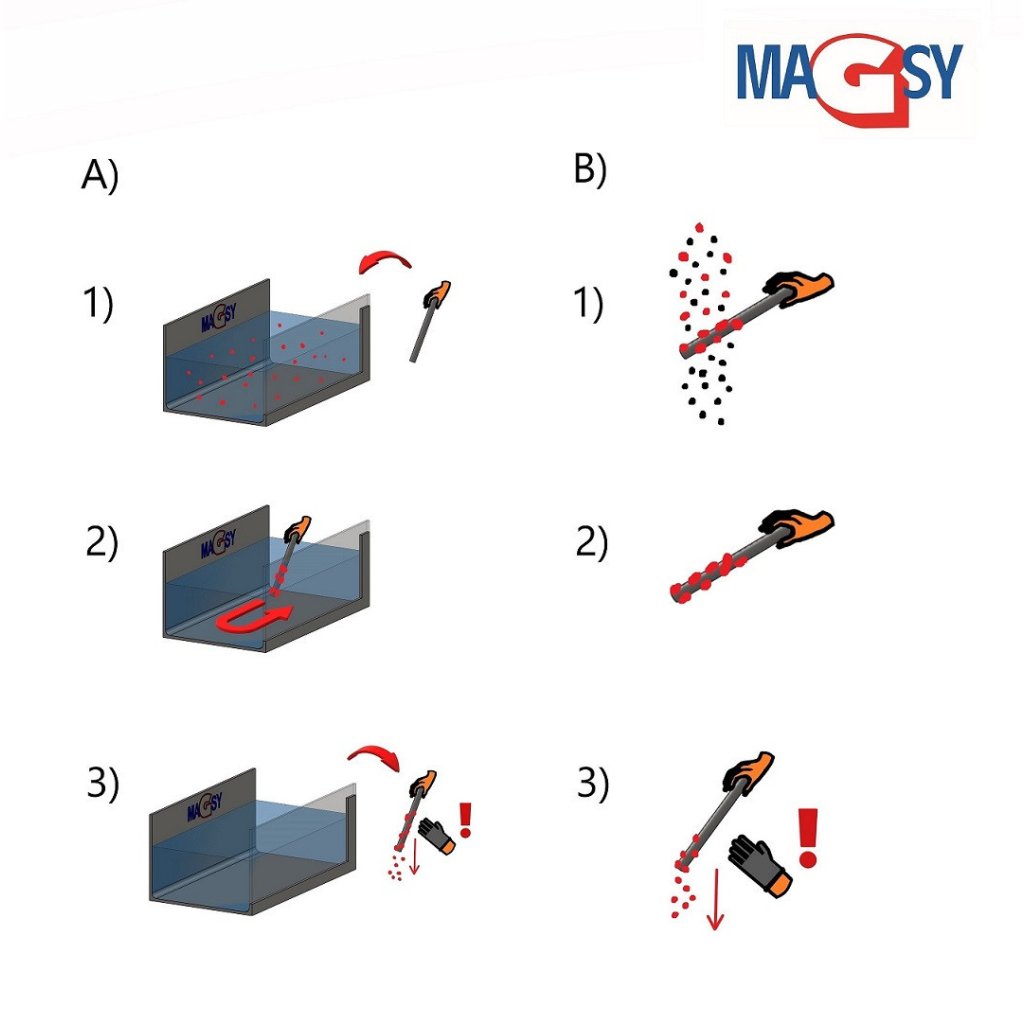
You can also use the magnetic rod on its own by directly placing it freely into the material, both into dry material and liquid material. It is resistant to moisture, so it can be immersed (partially or even completely) in liquids. Do not insert the magnetic rod and do not use it in aggressive substances and acids. The pH of the liquid into which you place the rod (where you will use the magnetic rod) must be in the range from min. 6.5 to max. 8.5. If the liquid has a different pH, do not use the magnetic rod. Contact our technical-sales department for more information, confirmation of suitability of using the magnetic rod, or a recommendation of another product from our range.
The magnetic rod can also be used for magnetic separation from bulk mixtures (from dry material). Hang it freely, place it, position it in the place you consider best for the function of this magnetic rod. You can also mount it anywhere using a screw. The screw is not included with the delivery of the magnetic rod. Do not place or hang the rod where any ferromagnetic material is in its immediate vicinity or may occur, as the magnetic rod could attach to this material. There is a risk of injury to the operator and poor function of the magnetic rod (when a metal magnetic material acts on the magnetic rod permanently, its force is reduced, e.g. if the magnetic rod were installed very close to a ferromagnetic beam or placed into an iron (magnetic) trough). The minimum distance of all magnetic objects from the magnetic rod is 200 mm. If you are not able to ensure a place where the magnetic rod will not be in contact with magnetic objects (iron magnetic beams, hoppers, chutes, troughs, slides, various similar structures) do not use this magnetic rod. Contact our technical-sales department for more information, confirmation of suitability of using the magnetic rod, or a recommendation of another product.
You can therefore use the magnetic rod in an assembly of several magnetic rods or on its own, as stated either for liquids or for dry mixtures. Below we list examples of materials for which you can use the magnetic rod to separate metal magnetic contaminants (magnetic separation).
Note: all liquid materials must meet the pH requirements from min. 6.5 to max. 8.5; all dry bulk mixtures must meet the maximum material size stated in this text (diameter 0–3 mm, max. size 3x3x3 mm); likewise magnetic metals must not exceed the dimensions stated here (diameter 0–3 mm, max. size 3x3x3 mm). If your material has a larger grain size or you expect the occurrence of larger magnetic contaminants, do not use this magnetic rod and contact our technical-sales department to recommend a suitable product for your purposes.
Examples of materials that are suitable for magnetic separation using a magnetic rod:
- bulgur
- powdered mashed potatoes
- powdered potato dumplings
- cereals, various types
- granulated sugar
- powdered sugar (when making your own assembly of multiple magnetic rods, we warn about possible material clogging; we recommend pouring more slowly and distributing evenly over the entire area of the magnetic-rod assembly; when using a single magnetic rod there is no problem)
- chickpeas
- tea (dried and crushed, not dried or fresh leaves)
- lentils (with frequent use for large quantities of lentils, abrasion may occur; we point out possible faster wear of the stainless steel jacket)
- baby food
- crushed cocoa beans
- wood chips (very fine fraction; we point out worse flow properties)
- crushed PET bottles (when making your own assembly of multiple magnetic rods, we warn about possible material clogging; we recommend pouring more slowly and distributing evenly over the entire area of the magnetic-rod assembly; when using a single magnetic rod there is no problem)
- pumpkin seeds
- glaze in the ceramic industry
- rubber regrind
- rubber granulate (when making your own assembly of multiple magnetic rods, it must not contain fine hair-like residues after shredding, similar to fine threads; when using a single magnetic rod there is no problem)
- cooling water (maximum temperature 40°C)
- cooling emulsions, oils (maximum temperature 40 °C)
- chili seeds
- millet
- roux (beware of arching/bridging when making your own assembly of multiple magnetic rods)
- yogurts
- ground cocoa
- animal feed (free-flowing, similar in character to coarser flour up to coarser fractions; when using an assembly of multiple magnetic rods we recommend a larger spacing between individual rods; when using a single rod there is no problem)
- ceramic mass (liquid and bulk…in the case of bulk, watch for abrasion; check wear of the stainless cover jacket more frequently)
- ground cocoa
- ground coffee
- green coffee beans (beware of material abrasion at higher capacities)
- ketchups
- coconut flour
- baking powder
- curry sauce
- lavender oil
- gluten (beware of arching/bridging when making your own assembly of multiple magnetic rods)
- freeze-dried fruit
- poppy seeds (poppy seeds only, not whole poppy heads, not ground poppy)
- mint oil
- matcha powder
- meat-and-bone meal
- ground corn (we point out increased abrasion of this material; the magnetic rod can be used, but check wear of the stainless jacket more often)
- flour (beware of material clogging; we recommend pouring more slowly and evenly; when using an assembly of multiple magnetic rods we recommend a larger spacing between individual rods; when using a single rod there is no problem)
- milk
- fruit juices
- oat flakes
- fruit mixes for yogurts (rather placed individually in the material flow)
- plastic granulate (without glass additive; also must not contain fine hair-like residues after shredding, similar to fine threads)
- plastic pellets and regrind (without glass additive)
- ash (not hot, but cooled to the magnetic rod’s operating temperature)
- buckwheat
- soups (dried instant)
- tomato concentrates/pastes
- sand (dry, fine sand; we point out increased abrasion of this material; the magnetic rod can be used, but check wear of the stainless jacket more often)
- pudding powder (worse flow properties; pour slowly and, when making your own assembly of magnetic rods, distribute evenly over the entire area)
- various types of syrups
- rice (hulled and unhulled, beware of abrasion)
- rapeseed oil
- sesame seeds
- sunflower seeds (we point out the possibility of increased abrasion and increased risk of wearing through the stainless jacket; check its condition regularly)
- enamel / glassy mass (we point out the possibility of increased abrasion and increased risk of wearing through the stainless jacket; check its condition regularly)
- building materials (only free-flowing and non-abrasive, without glass and ceramic additives)
- salt (we point out possible shorter service life due to the material used; depends on frequency of use; contact the manufacturer to confirm suitability of use)
- soy
- building materials (only free-flowing and non-abrasive, without glass and ceramic additives)
- dried chocolate
- dried whey
- dried herbs
- dried spices (finely ground or very finely crushed)
- dried milk
- dried coconut
- bulk starches e.g. corn starch (pour slowly and distribute evenly over the entire area; risk of bridging; when using an assembly of multiple magnetic rods we recommend a larger spacing between individual rods; when using a single rod there is no problem)
- sunflower oil
- soy sauce
- dried onion
- tobacco
- tapioca pearls
- dough mixes (powdered)
- hulled pumpkin seeds
- vanilla sugar
- liquid mixtures in general (by freely placing the magnetic rod; observe the prescribed pH, maximum material temperature 40 °C, and particle size in the material)
We point out that the wall (housing) thickness of the magnets—the stainless steel tube—is very small (very thin wall) in order to achieve high magnetic induction (magnetic force) and pull-off force on its surface. Therefore, please also consider the height from which you will pour the material onto the magnetic rod (impact height) when using the magnetic rod for bulk material. In general, the impact height should not exceed 1 m. However, this is individual for each type of material. When pouring from a great height, the stainless cover jacket may bend or be punctured and the entire magnetic rod may be damaged. If the height from which your material will be poured onto the magnetic rod is higher than 1 m, do not use this product and contact our technical-sales department to recommend another type of magnetic separator or to approve the use of this type of magnetic rod.
This magnetic rod captures (separates) ferromagnetic particles from a size of 1 µm and smaller (metallic, unmeasurable, magnetic dust) up to a diameter of 3 mm (3x3x3 mm), which is the maximum fraction (size) of material that may fall onto the magnetic rod and that may be poured over the magnetic rod. For liquid mixtures, such a large material fraction is not expected, but in this case it represents the maximum size of a ferromagnetic metal contaminant. Larger objects must not fall onto the magnetic rods (larger objects must not flow through the magnetic rods) than stated (max. diameter 3 mm, 3x3x3 mm). If you are concerned about the presence of larger ferromagnetic metal or other contaminants/admixtures, it is necessary to install a sieve with a mesh size of max. 3 mm upstream so that these larger unwanted objects are captured before contacting the magnetic rod. The sieve is not included with the delivery of the magnetic rod. We also point out the possibility that your material (dry or liquid) may contain a very large amount of fine metal contaminants (very fine metallic magnetic dust) that can “coat” the magnetic rods and, in the case of an assembly of multiple magnetic rods next to each other, block the assembly. At the same time, the magnetic force will be greatly reduced—this also applies to a magnetic rod used on its own. If the magnetic rods immediately become coated and completely “hidden” in iron dust, this is not a defect of the magnetic rod; magnetic separation must be strengthened with another magnetic rod or another type of magnetic separator. Likewise, more frequent cleaning of the magnetic rod may be sufficient.
If you are not able to ensure this (absence of larger particles in your material, very large amount of fine metal dust in your material), <
Additional parameters
| Category: | Magnetic separators |
|---|---|
| EAN: | 8595134062267 |
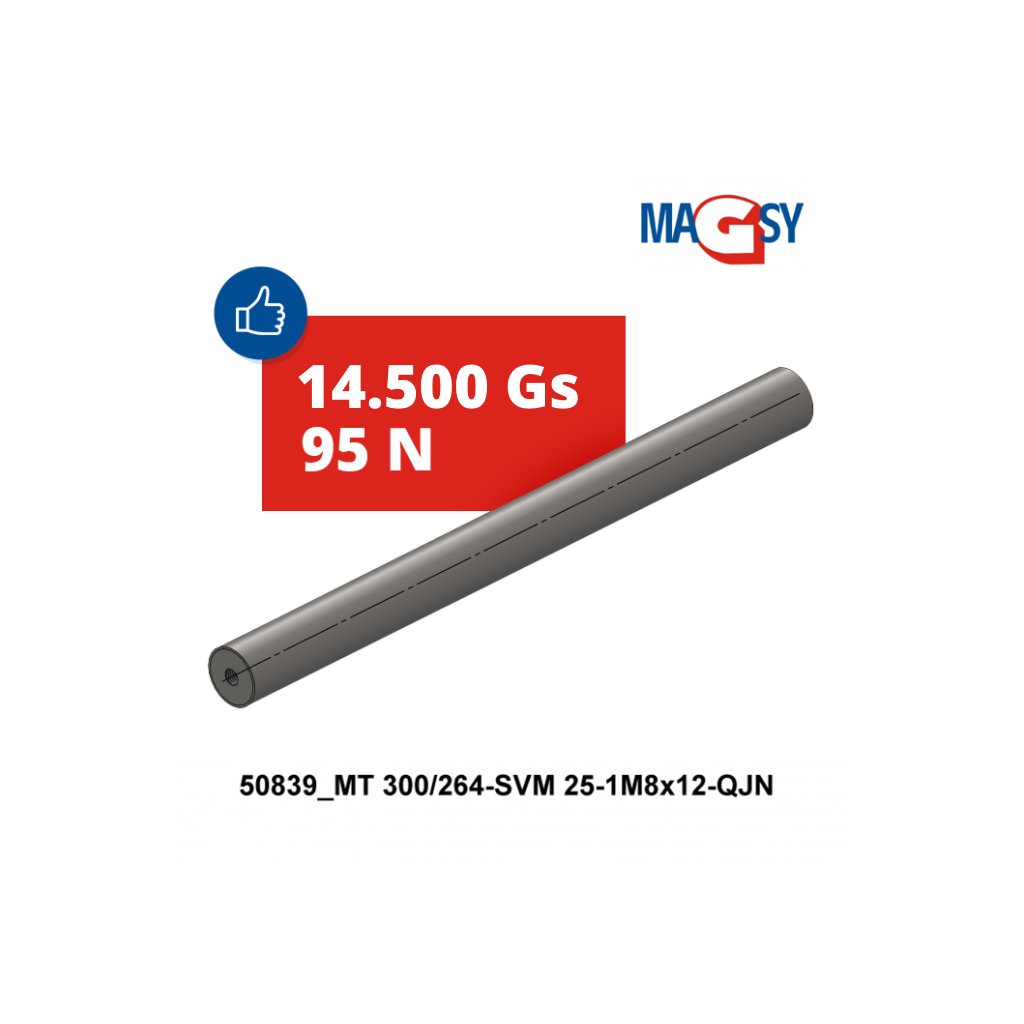
| Total length (mm): | 300 |
| Magnetic surface length (mm): | 264 |
| Weight (kg): | 1,1 |
| Magnetic induction (Gs): | 14.500 |
| Breakaway force (N): | 95 |
| Rod diameter (mm): | 25 |
| Temperature resistance (°C): | 80 |
| Thread: | M8x12 |
Magnetická tyč - NdFeB pr.25 x 300 mm, 14.500 Gs, 95 N, 80 °C
Be the first who will post an article to this item!